
A new regulation is taking effect. Next-generation equipment must be put into service. A maintenance procedure is changing. A new protocol must be implemented.
These are all situations that are all too familiar to training managers and campus administrators, who must regularly adapt to the changes inherent in their work.
And when a major change is announced, a question usually follows: When? ? And it’s often at that moment that the magnitude of the challenge becomes clear…
How can we ensure that everyone involved is ready by the time the new practice needs to be implemented?
Identify employees who need training, design training programs and sessions, recruit the right instructors, reserve the necessary resources, work around production constraints, coordinate across multiple sites…
A brain teaser already complex, with a deadline often non-negotiable as a bonus.
And that’s not even counting the unexpected challenges of daily life: an absence, a session that needs to be rescheduled, equipment that’s unavailable… or even a change in standards, procedures, or the schedule while the project is underway.
So this goes far beyond simply organizing a training campaign!
Identify exactly which teams are involved
This is the first issue to address, and it’s less straightforward than it seems.
As a process evolves, thinking solely in terms of job roles can quickly lead to inaccuracies.
Let’s consider a piece of industrial equipment whose maintenance procedure is changing. Not all technicians necessarily work on this equipment. Among those who do, some perform only first-level maintenance, while others handle more complex tasks. Supervisors may also be involved, as well as certain external service providers.
The target audience for training may therefore depend on several factors: job function, skills possessed, security clearance level, equipment used, assignment location, or the nature of the operations carried out.
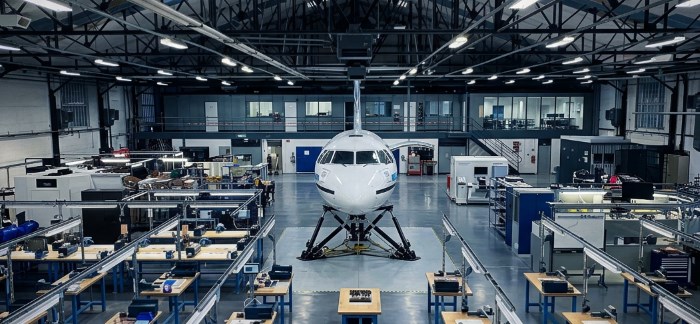
The aviation industry is a particularly good example of this approach. European rules on continuing airworthiness stipulate that competencies must be assessed based on the role performed and that qualifications determine, among other things, the tasks a person may perform, supervise, or certify.
Avoid making it too wide… or not wide enough
Systematically training an entire population may seem simpler.
This helps secure the perimeter, but it also consumes training resources that may be in short supply: employee time, instructors, classrooms, equipment, or simulators.
Conversely, segmentation that is too broad may leave out some employees who are essential to a team’s functioning.
Determine how the training should be implemented
Once the relevant employees have been identified, it is necessary to define How to bring them up to the expected level within the allotted time.
Let's assume for now that the training content has already been defined. The task now is to translate these instructional needs into implementation guidelines that are specific enough to allow us to then develop the schedule.
Define the route and its sequence
When rolling out a training program, it is necessary to define its sequence precisely. Some training courses can be taken independently. Others have prerequisites, must be taken in a specific order, or can only be taken once a certain skill has been acquired.
The same program may also require different sessions depending on the initial level of the participants.
In short, we need to define the appropriate pathway for each population, but also the order in which the various steps must be carried out.
This structure makes it possible to move from a course catalog and a curriculum outline to a a model that can actually be scheduled.
Choose the pace and priorities of the deployment
All that's left is to decide How to schedule training over time.
Should we train the entire workforce as soon as possible? Spread the training sessions out over several weeks or months? Proceed on a site-by-site basis? Prioritize certain teams?
The answer depends, in particular, on how the change itself will be implemented on the ground.
When gradually rolling out new equipment, it may be advisable, for example, to prioritize training the teams that will be the first to use it. Conversely, a new requirement that applies everywhere on the same date requires planning backward from that deadline.
These trade-offs make it possible to set a target pace: What needs to be ready, when, and in what order?
Identify the necessary resources and constraints
Finally, we must determine the conditions necessary for completing each step of the process.
What kind of trainer can conduct the training? Is any specific skill or certification required? Is a special room, simulator, or other equipment needed? What time slots can be set aside for training? Are certain resources available only at specific locations? Can the teams travel to those locations?
This is often where deployment plans begin to come up against reality.
This is because the new training campaign is not taking place in a vacuum. The training programs already underway continue, as do mandatory training, refresher courses, new employee onboarding, and the organization’s other priorities.
A deployment schedule that seems ideal on paper may therefore prove to be incompatible with the actual available capacity.
Identifying this tension early enough still allows for flexibility: adjusting group assignments, bringing in more trainers, changing the pace, prioritizing certain groups, or reallocating a critical resource.
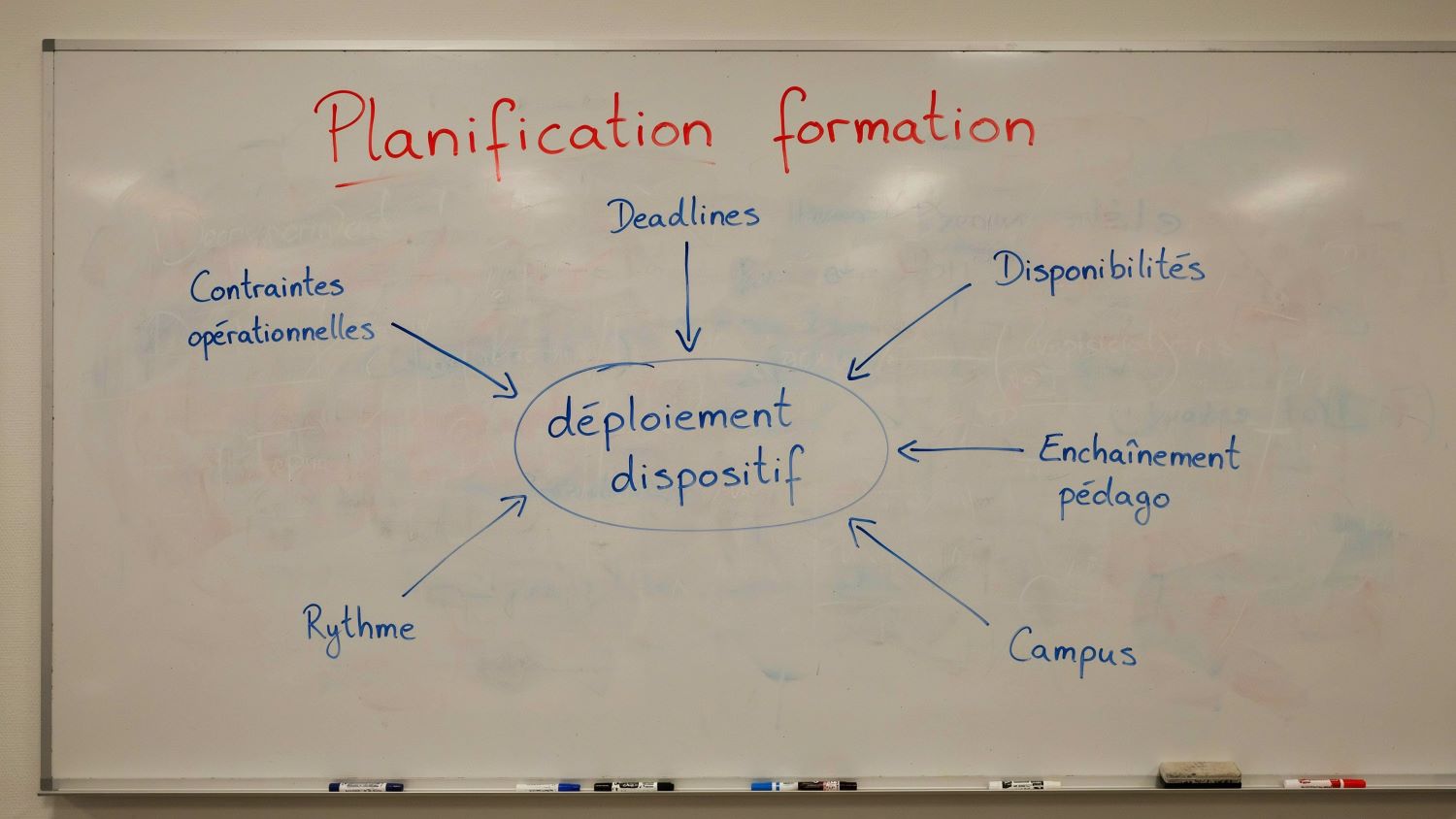
At this stage, we have everything we need to guide the planning of training programs related to this change: the target groups, the steps involved, their sequence, the priorities, the expected pace, the necessary resources, and the deadline to be met.
Now we just need to turn all these rules into a workable schedule…
Create and optimize the deployment schedule
That's often where things get complicated…
And as volumes increase, the process becomes more complex. Each session must be scheduled at a time that works for the employees involved, with the right trainer(s), the necessary training materials, and, in some cases, at a specific location. All of this must be done while adhering to the established schedule and without conflicting with training sessions that have already been planned.
Creating a training schedule… that’s realistic
On a small scale, it is still possible to manually search for the right combinations. Excel or your TMS may then be sufficient.
But when you have to organize dozens or even hundreds of sessions, spread out over several weeks and sometimes across multiple locations, the number of possibilities increases very quickly.
Changing one element can then affect several others: moving a session frees up an instructor but makes a piece of equipment unavailable; changing a group resolves an availability conflict but no longer follows the correct sequence of the course; adding a session speeds up deployment but ties up a resource already needed for another training session…
This is, in particular, the role of the planning engine inADE Entreprise is to take into account the tasks to be organized, availability, skills, resources, and all constraints to find the right combinations and create a viable, conflict-free schedule.
Don't just plan—optimize
A schedule that works is the bare minimum required for your training sessions, whether you’re rolling out a major update or organizing day-to-day training.
However, this is still far from the optimal level of planning.
Why? Because you might, for example, think you’re unable to organize more training sessions given the pressure on your centers, when in reality… You still have the capacity to train more people.
This is where optimization takes over from simple planning: Identify, from among the possible schedules, the one that best meets the organization's objectives.
This could be a schedule that gives your teams days off or preserves capacity at certain campuses. A schedule that prioritizes in-house trainers over external instructors. Or a schedule that limits travel between your various locations.
In ADE Entreprise, you can generate schedules that incorporate and adhere to all your constraints, while being optimized according to YOUR priorities.The result is therefore no longer simply a conflict-free schedule. It’s a schedule capable of delivering training within the planned timeframe, while making the best use of available resources and meeting the organization’s other requirements!

Adapt the deployment to unforeseen circumstances
Even the best schedule is bound to change.
A trainer who can't make it, equipment that's out of commission, a team that ends up being unavailable due to production demands, a session that has to be rescheduled… The usual challenges of training, of course, continue to arise as the program is rolled out.
In addition to these, there may be factors directly related to the change itself: a delayed effective date, an adjusted procedure, a revised schedule for putting equipment into service, or new groups of people who need to be trained…
In short: many factors will disrupt the carefully crafted schedules… with the risk of a domino effect.
Respond without disrupting the rest of the schedule
When faced with an unexpected situation, the challenge isn't simply to find a new time slot. It's to change the schedule without creating new problems elsewhere.
A rescheduled session can disrupt the sequence of a course. A change in instructor may require verifying the instructor’s qualifications or availability. A resource that is no longer available may necessitate rescheduling several sessions.
And when the deployment is subject to a deadline, every change raises an additional question: Will we still be able to train everyone in time?
That is why the re-planning must be based on the same rules as the initial planning.
Share the right information with the right people
Changes don’t just affect planning; they can also lead to misunderstandings and errors if there isn’t proper communication.
Rescheduling therefore involves distributing updated schedules to all relevant employees: managers, interns, trainees, instructors, and others…
ADE Entreprise helps maintain smooth communication through notifications and its portal, which displays schedules that are always up to date. You can also sync the schedule with your work or personal calendars using iCal links.
Successfully Implementing a Regulatory or Operational Change
Preparing your teams for regulatory or operational changes is therefore not just a matter of designing the right training program.
You have to be able to to coordinate its rollout all the way to the field : to determine exactly who needs training, what training path they should follow, and in what order, and then translate these requirements into a feasible, optimized schedule that is flexible enough to accommodate unforeseen circumstances.
Because there’s sometimes a world of difference between a training program that’s ready to be delivered and hundreds—or even thousands—of employees who are actually trained on time.
This is precisely where ADE Entreprise comes in. The solution makes it possible to create, optimize, and adapt training schedules while taking into account the organization’s educational, personnel, equipment, and operational constraints.
The goal: to ensure that the right people are trained at the right time, so that the changes can actually be implemented on the ground.