
In January, the training plan is approved, budgeted, and presented to the CSE. In June, some of the sessions are underutilized, others are overbooked, and managers are requesting training courses that aren’t included in the plan.
The plan wasn't bad—it just stopped taking the situation into account. Alignment isn't something you can simply decree when you create the plan. It's earned through the way needs are translated into sessions, and then through the way those sessions are adjusted throughout the year.
Why is the training plan falling short in practice?
Because it is designed as an annual document, even though needs are constantly changing. And because, between the time a need is identified and the session is actually held, a series of operational constraints can affect its feasibility.
This finding is by no means an isolated one: according to the 2023 Cegos Barometer, 41% of HR managers surveyed internationally—and 37% in France—struggle to align training offerings with their organisation’s skill needs. Four causes come up almost every time.
01
An offbeat rhythm
The plan is developed once a year. New hires, transfers, new equipment, and certification deadlines, however, occur throughout the year.
02
Misclassified needs
"Train the maintenance team on the new production line": How many people, at which sites, by what date, and what are the prerequisites? Without these details, the need cannot be planned.
03
Information that gets lost along the way
Between the manager who identifies the need, the training department that evaluates it, and the scheduler who schedules it, essential details get lost at each stage.
04
Fragmented tools
HRIS, TMS, Excel: No one has a complete picture of what’s being requested, what’s feasible, and what’s actually being done.
Where can we identify people’s actual needs, beyond the job interview?
The career counseling interview has long been the cornerstone of needs assessment. Its role is changing: as of October 26, 2025, Law No. 2025-989 replaced it withthe career path interview, which is conducted within one year of hiring and then every four years, with a summary review every eight years (compared to every two and six years previously).
This review remains valuable for individual development plans. But if it was already too infrequent to address operational needs, it is even less so today. The best-aligned organisations therefore draw on multiple sources:
- Front-line managers, on a regular basis. A 15-minute quarterly check-in with each team, focusing on three questions (“What’s coming up?”, “What’s changing?”, “What’s causing problems?”), yields more useful insights than an annual campaign.
- Skills and authorizations data. An authorization that expires in September is a need we already know about today. An up-to-date skills matrix makes some of these needs predictable: that’s the whole pointof a skills and authorizations management tool like ADE Skills, which links skills statuses directly to planning.
- Operational signals. Incidents, audit nonconformities, equipment commissioning, site reorganization: these are all training needs that are rarely identified as such.
- Strategy and Workforce Planning. Bottom-up needs (new job roles, technical transformation, and skill development in AI) complement the feedback from the field.
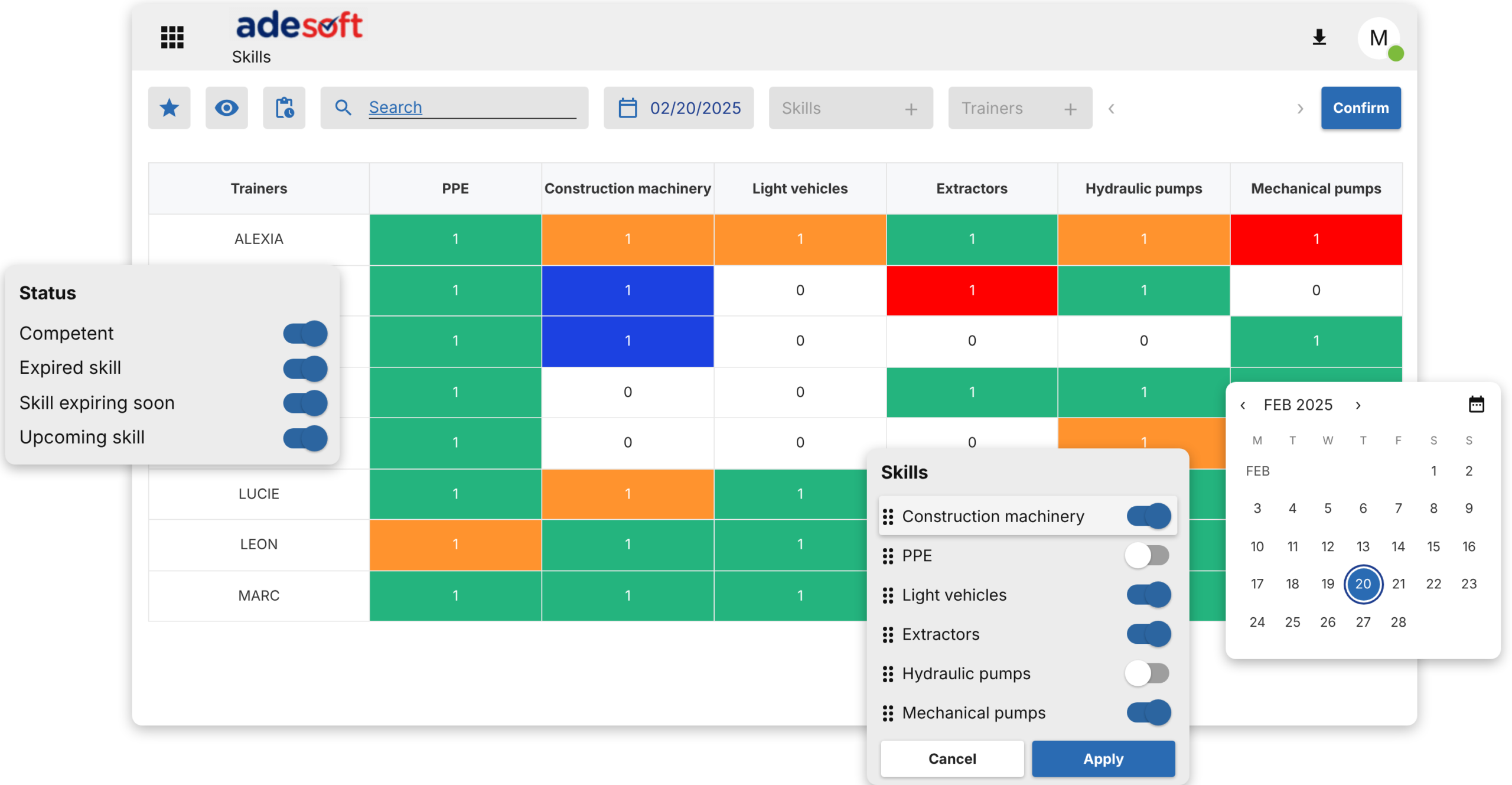
Do you have a training need or request?
A request is a specific request (“I would like to take this course”). A need is a gap between the skills a person possesses and those required for the position. Aligning the plan with reality means starting with the needs and then verifying that the requests address them.
How can we assess and prioritise needs without misrepresenting the situation on the ground?
Not all needs carry the same weight. A three-tier hierarchy avoids having to make decisions on a case-by-case basis:
- Required: regulatory training, certifications, and safety. Non-negotiable, with specific deadlines.
- Strategic: Skills related to company projects or the performance of a business unit.
- The goal: individual development and skill-building outside of emergency situations.
However, this hierarchy is not enough. The link that is most often overlooked is operational qualification. A need that is ready to be planned answers five questions: who (target population, number of participants), where (relevant sites), when (deadline), what (module or course, prerequisites), and with what resources (certified instructors, classrooms, equipment).
Key Takeaways
Without operational criteria, decisions are based solely on the budget. However, the real constraint often lies elsewhere: in training capacity—that is, the number of sessions the organisation can actually hold given its trainers, training rooms, and the availability of its staff.
Why doesn't a validated need always result in a session?
This is the breaking point that most approaches underestimate. A validated need is merely an intention. To become an actual session, it must navigate a set of interrelated constraints.
EXAMPLE
A recertification program to be organised before the end of the year at an industrial or energy company
On paper, the math is simple: 100 days of training. In practice, the problem takes on a different nature:
- Only four instructors are authorized to teach this module;
- Technical facilities are available at only three locations, which requires travel;
- Each team cannot assign more than two or three technicians at a time without compromising service;
- Busy periods and holidays block off part of the calendar;
- Some technicians must first complete a prerequisite module.
Each constraint narrows the range of possible solutions: a session cannot be scheduled simply because a time slot appears to be available. At this level of complexity, a spreadsheet merely stores the data; it is up to the scheduler to resolve the constraints manually. And many TMS systems, designed to manage the training process (registration, invitations, tracking), offer scheduling capabilities that do not take all these rules into account simultaneously. We have observed this in detail when scheduling technical training in the industrial sector.
To take this step forward, you need a tool capable of taking all constraints into account at once. Training scheduling software designed for constrained environments, such as ADE Planning, generates the sessions needed to cover all target groups, schedules them over time, and proposes a schedule that takes into account availability, skills, capacity, and travel. The scheduler retains control to make adjustments.

How can we stay on track when things keep changing throughout the school year?
The initial plan is just a starting point. New hires, absences, cancellations, an unavailable trainer, or an urgent need following an incident: planning also involves adapting as things unfold. Three practices make all the difference.
01
Reserve Capacity
Leave some wiggle room in the trainers' and rooms' schedules (10 to 15% is a good starting point) to accommodate unforeseen circumstances without having to reschedule everything.
02
Reschedule by Impact
Before rescheduling a session, assess the resulting chain reaction: prerequisites for a course, expiring authorizations, and additional travel.
03
Open at the right time
Manage session scheduling based on attendance levels to avoid tying up an instructor and a classroom for a session that’s only half-full.
What indicators show that a plan is aligned with on-the-ground realities?
The plan’s completion rate is the most closely monitored—and most misleading—indicator: a plan can be 95% complete while still failing to meet needs on time or addressing the wrong ones. It’s better to have a concise dashboard that examines the situation from multiple angles:
- Time between need identification and training: the time elapsed between the identification of a specific need and the completion of the training session. This is the most direct indicator of alignment.
- Coverage of authorizations upon expiration: the percentage of authorizations renewed before they expire.
- Session occupancy rate: This indicates which sessions are poorly scheduled or poorly located.
- Rescheduling rate: A high volume indicates that a plan was developed without taking actual constraints into account.
- Manager Satisfaction: Their perception of the training department's responsiveness, as measured by a simple question asked twice a year.

What a Planning Tool Really Changes
Each tool has its own scope. The TMS manages the training process (course catalogue, registration, invitations, administrative follow-up), while the LMS manages learning content, as we explained in our TMS vs. LMS comparison. Excel, on the other hand, is often used as a default solution for planning—until the day when the volume and constraints make it unmanageable.
A dedicated planning tool covers the intermediate stage—the one where alignment really takes place. It bridges the gap between the needs identified by HR and training tools and the sessions that are actually held: it generates sessions in bulk, schedules them while taking all constraints into account, and allows for quick reorganization when circumstances change. Our guide also details the limitations of TMS systems when it comes to training planning.
That is the roleof ADE Entreprise, Adesoft’s corporate training planning solution, which is designed to integrate with existing HRIS and TMS systems rather than replace them.
Feedback
At ORES, the operator of Wallonia’s power distribution network, the time spent on planning was cut in half in just three months with ADE Entreprise. The time saved is used to better target participants, resulting in sessions with higher attendance.
Does your organisation really need planning software?Look for these 10 telltale signs.
Is Your Plan Aligned with Reality? 8 Questions to Find Out
- Are requests submitted more than once a year?
- Are authorization deadlines automatically incorporated into the requirements?
- Does each approved requirement specify the number of employees, locations, deadline, and prerequisites?
- Do you know your actual training capacity (trainers, classrooms, staff availability)?
- Does the plan allow for unforeseen needs?
- Do you track the time between when a need is identified and when training is completed?
- Is a schedule change evaluated based on its ripple effects?
- Do managers have visibility into the sessions scheduled for their teams?
Frequently Asked Questions
What is the difference between a training plan and a skills development plan?
The skills development plan has replaced the training plan since the law of September 5, 2018. It covers a broader range of development initiatives, but the challenge of aligning with on-the-ground needs remains the same.
How often should training needs be assessed?
On an ongoing basis for operational needs (managers, authorizations, field events), and once a year for strategic and budgetary consolidation. The career development interview, now held every four years, is not sufficient on its own.
How do you prioritise needs when the budget isn't enough?
By addressing mandatory requirements first, then strategic ones, and by verifying the available training capacity before committing the budget. Better planning often makes it possible to hold more sessions with the same resources.
Who is responsible for approving training needs?
The manager assesses the need, the training department evaluates it in light of priorities and the budget, and the planning department confirms its feasibility. All three perspectives are necessary.
How can we measure the alignment of the plan with the actual site conditions?
By looking at the time lag between identified needs and training, the coverage of certifications upon expiration, the enrolment rate, the rescheduling rate, and manager satisfaction—rather than just the completion rate.
What software should we use to plan training based on the identified needs?
A TMS effectively manages registrations, invitations, and administrative follow-up. To translate requirements into scheduled sessions that account for various constraints (certified instructors, rooms, staff availability, and multi-site operations), you need a dedicated planning tool like ADE Entreprise, which integrates with existing HRIS and TMS systems.
What if the annual plan were just a first draft?
The organisations that best align their training with real-world needs are not the ones that develop the most comprehensive plan in January. They are the ones that accept that the plan will change and equip themselves to adapt it without losing overall coherence.
The question is no longer whether the plan will be followed, but how quickly it will be able to keep pace with developments on the ground.
Develop a training plan that stands up to real-world challenges
Our guide, “6 Steps to Developing Your Training Plan,” walks you through the process from needs assessment to follow-up.